Practical, evidence-informed training guidance
Puppy Training Guides for First‑Time Owners
Each guide starts from what you are seeing with your puppy, explains what may be happening, and gives you a practical first step and what to watch next.
Free printable plans PDF · no sign-up
Two first-year plans, ready to print
Two of the guides as free PDFs to print, each with worksheets to fill in.
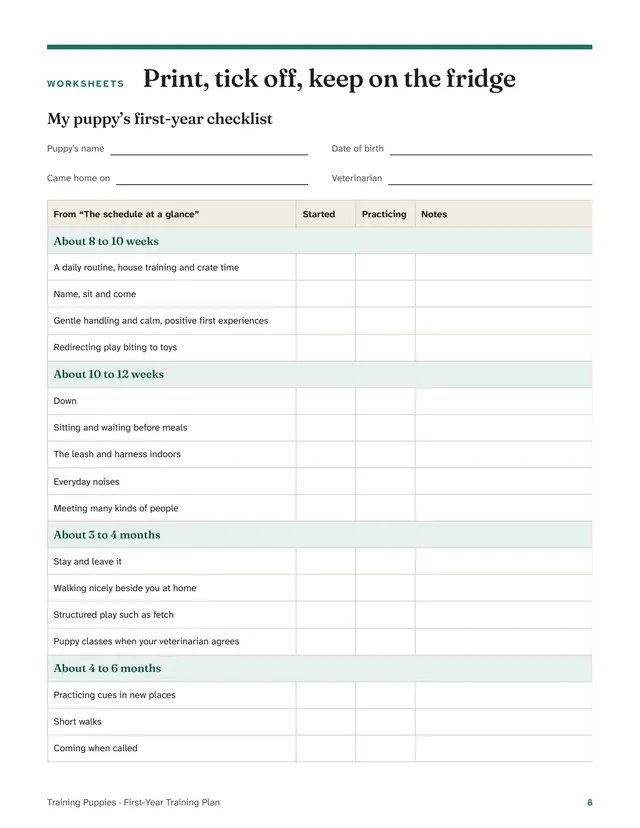
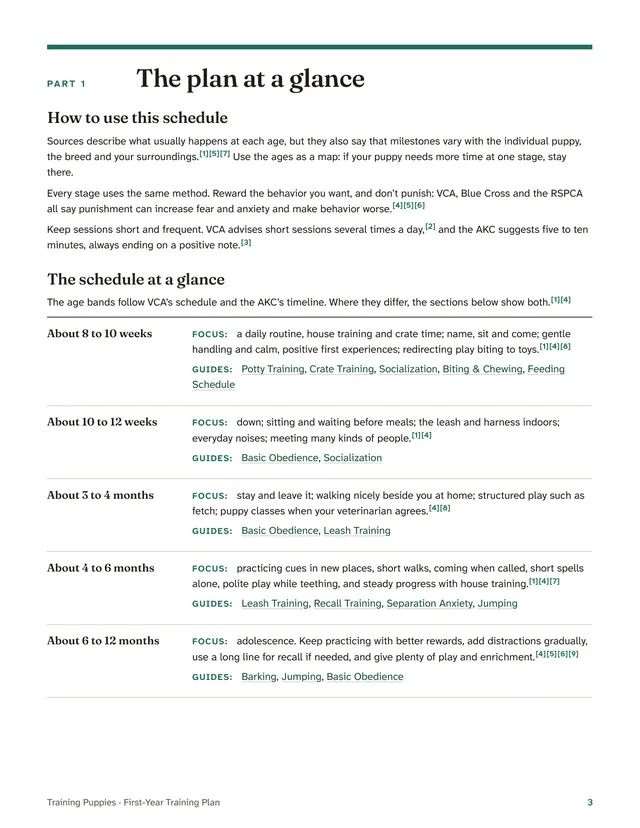
3worksheets to fill in
The first-year training plan
The Puppy Training Schedule by Age as a free printable PDF: what to work on at each age, from 8 weeks to 12 months.
- The schedule at a glance, age by age
- Three stages, from 8 weeks to 12 months
- A checklist and practice log to fill in
PDF · 11 pages · 0.6 MB
Prefer to read it now? Read the schedule online
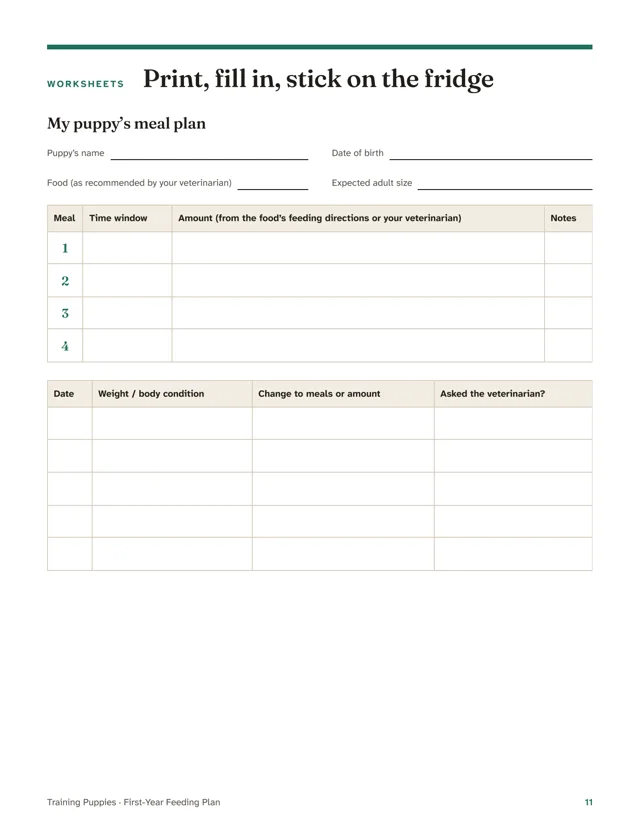
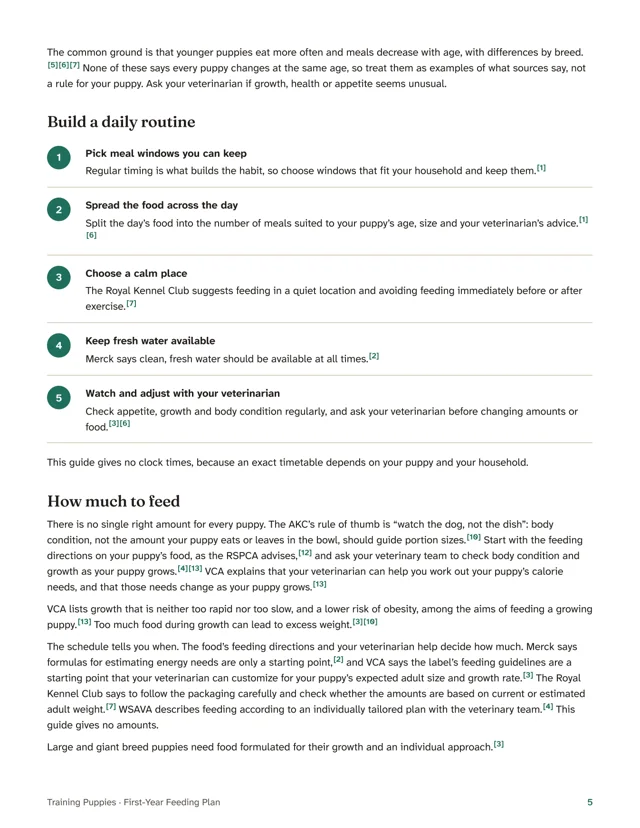
2fill-in worksheets
The first-year feeding plan
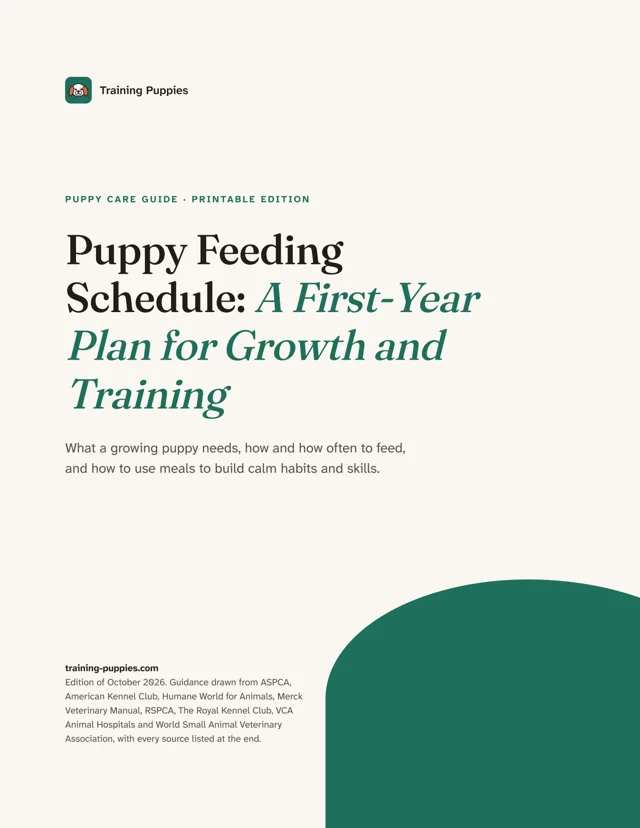
The full Puppy Feeding Schedule guide as a free printable PDF: what a growing puppy needs, how and how often to feed, and how meals build calm habits and skills.
- The plan at a glance, stage by stage
- A five-step daily routine
- A meal plan and one-week log to fill in
PDF · 14 pages · 0.6 MB
Prefer to read it now? Read the plan online
Usually normal, and when to ask for help
Not sure whether something is wrong?
Here is what the guides say, in their own words.
123
-
Usually, it is normal.
Mouthing, play biting and chewing are common in young puppies.
Biting & ChewingPulling, dawdling and leash chewing are usually training issues.
Leash TrainingHousetraining problems usually have training fixes, but not always.
Potty TrainingMost puppies adapt to a crate when it is introduced gradually, but not all do.
Crate Training
-
Normal does not mean it will fix itself.
Biting & Chewing
Watch three things:
- How does my body look?
- Is it getting better or worse?
- Is this new for me?
-
How does your puppy’s body look?
A playful puppy usually has a relaxed body and face.
Biting & Chewing · also Crate Training -
Is it getting better or worse?
Look elsewhere if your puppy’s biting seems fearful or angry rather than playful, keeps getting worse, or you cannot manage it safely.
Biting & Chewing · also Barking, Potty Training -
Is this new for your puppy?
Look elsewhere if your puppy seems unwell, or a puppy that was doing well starts having repeated accidents.
Potty Training · also Jumping, Basic Obedience, Leash Training -
!Ask for help first.
Unwell or in pain
Ask a veterinarian first if your puppy seems unwell or in pain, or their behavior changes suddenly, because medical problems can affect behavior.
Basic Obedience · also Biting & Chewing, Jumping, Leash Training, Potty Training, BarkingFear or panic
If your puppy seems panicked or cannot settle, stop crate training and ask a veterinarian or a qualified behavior professional.
Crate Training · also Leash Training, BarkingSafety
If your puppy seems unwell, its behavior changes suddenly, it seems fearful of people or reacts aggressively when greeted, or you cannot keep visitors safe, ask your veterinarian first, because medical concerns can affect behavior.
Jumping · also Biting & ChewingQuoted unchanged from the guides on Biting & Chewing, Leash Training, Potty Training, Crate Training, Basic Obedience and Jumping. The guides describe what to watch for; they cannot assess your individual puppy.
How a guide reads
Every guide follows the same shape. Here is the opening of one of them, unchanged.
Show this for:
A short answer, and who the guide is for
From Puppy Biting & Chewing · Short answer
Mouthing, play biting and chewing are common in young puppies. Give your puppy appropriate things to chew, calmly end play when teeth touch skin and offer a toy instead, manage what your puppy can reach, and never use physical punishment.
This guide fits you if your puppy mouths or bites hands and clothes during play, or chews things they should not.
Look elsewhere if your puppy’s biting seems fearful or angry rather than playful, keeps getting worse, or you cannot manage it safely. Ask a veterinarian first.
Practical things to try first
What to do in the moment · step 2 of 6
End the interaction calmly when teeth touch skin
Stop the game and turn off your attention by going still and looking away, or give a short, high-pitched “ouch” and let your hand go limp.
First step: What to do in the moment ↓What to check when it is not working
Your puppy bites harder when you pull away
- Check
- Whether you jerked your hands away or waved your fingers or toes in your puppy’s face.
- Try
- Go still, end the game, and offer a toy instead.
Linked sources, and when to ask a professional
If biting seems fearful or angry rather than playful, keeps getting worse, injures someone, or you cannot manage it safely, ask a veterinarian, who may refer you to a veterinary behaviorist or a certified applied animal behaviorist.
- Mouthing, Nipping and Biting in Puppies ASPCA
- Play Biting in Puppies VCA Animal Hospitals
Two of seven sources shown; the guide links all of them.
Excerpt from Puppy Biting & Chewing, unchanged.
Scope of these guides
These guides focus on puppy training and behavior management. They are not a substitute for veterinary care.
See your veterinarian for:
- Health questions (nutrition, vaccines, illness)
- Medical concerns (injury, digestive issues, allergies)
- Behavioral conditions requiring professional diagnosis
Photo sources and licences
- Biting: photo by cgride555, CC0 1.0, cropped.
- Jumping: photo by Holly Lay, CC BY 2.0, cropped.
- Barking: photo by Tony Alter, CC BY 2.0, cropped.
- Basic obedience: photo by emdot, CC BY 2.0, cropped.
- Leash: photo by kellinahandbasket, CC BY 2.0, cropped.
- Potty training: photo by USAG-Humphreys, CC BY 2.0, cropped.
- Crate: photo by Bev Sykes, CC BY 2.0, cropped.
- Separation anxiety: photo by Martin Cooper, CC BY 2.0, cropped.
- Socialization: photo by Faith Goble, CC BY 2.0, cropped.
- Puppy training schedule: photo by Andrea Arden, CC BY 2.0, cropped.
- Recall: photo by Lachlan Hardy, CC BY 2.0, cropped.
- Resource guarding: photo by Wonderlane, CC BY 2.0, cropped.
- Fear periods: photo by latteda, CC BY 2.0, cropped.
- Feeding: photo by Tony Alter, CC BY 2.0, cropped.
- Puppy proofing: photo by Puppy Pawrent, CC BY 2.0, cropped.