By the Training Puppies editorial team · Updated
Puppy care guide
Puppy Feeding Schedule: A First-Year Plan for Growth and Training
What a growing puppy needs, how and how often to feed, and how to use meals to build calm habits and skills.
Short answer
A puppy feeding schedule is when and how often your puppy eats. A regular routine makes mealtimes predictable and makes changes in appetite easier to notice.[1] It is a separate question from how much to feed, which depends on the individual puppy and is best settled with the food’s feeding directions and your veterinarian.[2][3]
This guide fits you if you want a practical meal routine and want to understand how meal frequency tends to change as puppies mature.
Look elsewhere if you want help reading food labels, comparing products, house training, crate training or behavior problems, or you need medical nutrition or a therapeutic diet. Your veterinary team is the expert source for those.[4]
What a feeding schedule is, and what it is not
A schedule covers when and how often. Dogs are creatures of habit, and VCA says a regular schedule builds a strong habit, gives security, makes diet changes smoother and makes appetite changes easier to spot.[1]
Three other questions are separate. How much your puppy needs depends on the individual. Nutritional adequacy is about whether the food is complete and balanced for a puppy: Merck says to look for puppy food with the AAFCO label, meaning it meets certain nutritional standards.[5] Medical or dietary treatment is for a veterinarian.[4] A schedule answers none of these.
VCA does not recommend leaving food out all day, because it can contribute to juvenile obesity and make it slower to notice appetite changes.[1][3]
What a growing puppy needs
Complete and balanced food for growth
Choose a food made for growth that is complete and balanced. VCA advises checking the label for a nutritional adequacy statement (an AAFCO statement) saying that the food has been formulated for growth.[13] The AKC notes that both wet and dry puppy foods can be complete and balanced, so either can meet your puppy’s needs.[10]
Three nutrients that matter most
VCA names three key nutrients to understand when choosing a diet for a growing puppy: protein, fat and calcium.[13]
- Protein is a source of energy and of essential amino acids. Puppies need the most protein right after weaning, and the amount steadily decreases after that.[13]
- Fat is a source of essential fatty acids. It is a concentrated source of energy and helps the body absorb fat-soluble vitamins.[13]
- Calcium: puppies need more calcium than adult dogs for skeletal growth, but too much can contribute to growth problems.[13]
Large and small breeds
The AKC notes that small and large breeds have different nutritional needs, especially as puppies.[10] VCA says calcium needs particular care in foods for large and giant breed puppies, which have the highest risk of growth abnormalities, and advises a food whose label says it is formulated for the growth of large-breed puppies.[13][3]
No supplements on top of a balanced diet
The ASPCA notes that with a complete and balanced diet a vitamin supplement is unnecessary unless a veterinarian diagnoses a deficiency.[11]
Water
The plan at a glance
Sources describe what usually changes as puppies grow. Use these stages as a map, not a rule for your puppy, and ask your veterinarian when you are unsure.
- About 8 to 12 weeks
Meals: The Merck Veterinary Manual’s owner version suggests four meals a day from 6 to 12 weeks.[5]
Watch: Appetite and steady growth; a change in appetite can be an early sign of a health issue.[3][8]
- 3 to 6 months
Meals: Merck suggests three meals a day from 3 to 6 months.[5] The Royal Kennel Club gives four meals at 2 to 3 months and two to three at 4 to 6 months.[7]
Watch: Treats and training food count toward the day’s food.[13][15]
- Around the first birthday
Meals and food: Moving to adult food depends on size, and sources give different ages; see Moving to adult food.[5][10][14]
How meal frequency changes as puppies mature
Younger puppies generally eat more often, and the number of meals tends to fall as they grow. VCA explains that several meals break the day’s food into smaller portions for a puppy’s small stomach.[1] Sources give different ranges, so here is what each says.
- Merck Veterinary Manual, owner version
Four meals a day from 6 to 12 weeks, three from 3 to 6 months, two from 6 to 12 months, then one or two with an adult diet.[5]
- Merck Veterinary Manual, professional version
Three times daily from weaning to 6 months and twice daily from 6 to 12 months, noting that small-breed puppies may need more than three feedings.[6]
- VCA Animal Hospitals
Three to four meals a day can be helpful for puppies.[1]
- The Royal Kennel Club
Four to six meals a day at weaning, four at 2 to 3 months, two to three at 4 to 6 months, and two after 6 months, depending on breed.[7]
The common ground is that younger puppies eat more often and meals decrease with age, with differences by breed.[5][6][7] None of these says every puppy changes at the same age, so treat them as examples of what sources say, not a rule for your puppy. Ask your veterinarian if growth, health or appetite seems unusual.
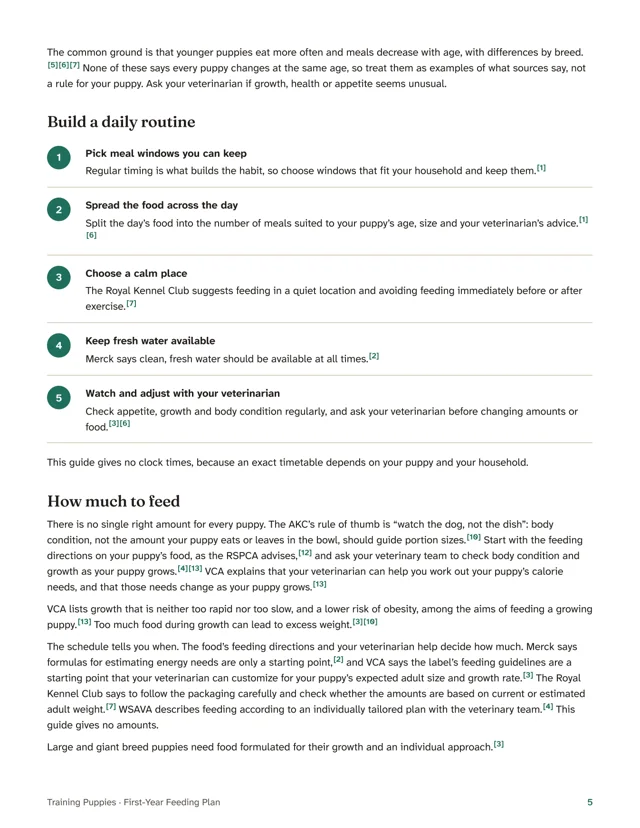
Build a daily routine
- 1
Pick meal windows you can keep
Regular timing is what builds the habit, so choose windows that fit your household and keep them.[1]
- 2
- 3
Choose a calm place
The Royal Kennel Club suggests feeding in a quiet location and avoiding feeding immediately before or after exercise.[7]
- 4
Keep fresh water available
Merck says clean, fresh water should be available at all times.[2]
- 5
This guide gives no clock times, because an exact timetable depends on your puppy and your household.
How much to feed
There is no single right amount for every puppy. The AKC’s rule of thumb is “watch the dog, not the dish”: body condition, not the amount your puppy eats or leaves in the bowl, should guide portion sizes.[10] Start with the feeding directions on your puppy’s food, as the RSPCA advises,[12] and ask your veterinary team to check body condition and growth as your puppy grows.[4][13] VCA explains that your veterinarian can help you work out your puppy’s calorie needs, and that those needs change as your puppy grows.[13]
VCA lists growth that is neither too rapid nor too slow, and a lower risk of obesity, among the aims of feeding a growing puppy.[13] Too much food during growth can lead to excess weight.[3][10]
The schedule tells you when. The food’s feeding directions and your veterinarian help decide how much. Merck says formulas for estimating energy needs are only a starting point,[2] and VCA says the label’s feeding guidelines are a starting point that your veterinarian can customize for your puppy’s expected adult size and growth rate.[3] The Royal Kennel Club says to follow the packaging carefully and check whether the amounts are based on current or estimated adult weight.[7] WSAVA describes feeding according to an individually tailored plan with the veterinary team.[4] This guide gives no amounts.
Large and giant breed puppies need food formulated for their growth and an individual approach.[3]
Treats and food used in training
People food and scraps
The RSPCA notes that most human meals won’t give dogs the nutrition they need, and that some human foods, such as chocolate and onions, can be poisonous to dogs.[12] The AKC warns that a steady diet of table scraps can create a nutritional imbalance and lead to weight gain, and suggests keeping extra food for training rewards.[10]
Moving to adult food
Puppies stay on a food formulated for growth until they are close to adult size, and the timing depends on size. Sources give different ages:
- AKC
Small-breed puppies can switch to adult food at 7 to 9 months, and larger breeds at 12, 13 or even 14 months. It is better to stay on puppy food a little too long than not long enough.[10]
- VCA Animal Hospitals
Small- and medium-breed dogs should stay on a growth food until about 12 months, with adult food introduced slowly from about 10 months.[14] Puppies mature by about 10 to 12 months in small and medium breeds, and up to 18 to 24 months in large and giant breeds.[13]
- Merck Veterinary Manual, owner version
The feeding schedule lists an adult diet from 12 months.[5]
Meals that build skills
Every meal is also a chance to practise. The AKC suggests using your puppy’s food for more than nourishment: for enrichment, mental exercise, training and bonding.[16]
A predictable routine helps house training
Feeding at the same times each day makes house training easier. Humane World for Animals explains that puppies usually need to relieve themselves soon after eating, so regular meals lead to predictable potty times.[19] The AKC lists “after meals” among the times to take your puppy outside.[20] The Puppy Potty Training guide covers the outdoor routine.
Mealtime manners: calm first, then the bowl
The AKC suggests asking for a calm behavior before the bowl goes down, because feeding an over-excited puppy rewards the excitement. Ask your puppy to sit or lie down, and lower the bowl only while they stay calm. If they pop up, lift the bowl, ask again, and then release them to eat.[16] Sit and down are taught in the Puppy Basic Obedience guide.
Part of the meal as training rewards
You do not need extra treats for every training session. The AKC suggests setting aside part of the day’s food to reward behaviors you want, such as lying quietly, or carrying it on walks to reward loose-leash walking.[16] VCA also lists feeding during training as one way to enrich a pet’s day.[17] Food used this way still counts toward the day’s total.[10] Loose-leash walking is covered in the Puppy Leash Training guide.
Hand feeding for focus and trust
Hand feeding some meals builds your bond and teaches your puppy that good things come from you; the AKC adds that it encourages focus.[16] The ASPCA recommends hand feeding several meals as soon as you bring a new puppy home, as part of preventing food guarding.[18]
Food puzzles and slow feeders
Food puzzles and slow feeders turn a meal into an activity. VCA says food puzzles slow the rate of eating and keep a pet mentally stimulated.[17] The AKC adds that slow feeders suit puppies that gulp their food, and that a meal scattered on grass or a snuffle mat lets your puppy use their nose. Start easy and make it harder gradually.[16] Supervise your puppy with any new puzzle or homemade toy.[17]
Preventing food guarding
The ASPCA explains that puppies are prone to guarding food because they often compete with littermates for it. To prevent guarding, it suggests starting with hand-fed meals, then holding the bowl while your puppy eats, then occasionally dropping something especially tasty into the bowl on the floor as they eat, during the first months at home.[18]
- Do not punish or intimidate a puppy that guards food, and do not take the food away to “show who is in charge”. The ASPCA says this can make guarding worse.[18]
- If your puppy growls, snaps or bites over food, do not try to fix it yourself. The ASPCA advises getting help from a qualified professional, such as a certified applied animal behaviorist or a veterinary behaviorist.[18]
The Resource Guarding in Puppies guide covers the early signs, what not to do and when to get help.
Meals and the crate
Meals can help your puppy like their crate. Humane World for Animals suggests feeding regular meals near the crate, then gradually further inside it, to create a pleasant association.[21] The Puppy Crate Training guide covers each step, and the Puppy Separation Anxiety guide suggests making your puppy’s resting place rewarding by feeding meals there.
What to watch
VCA notes that a change in appetite is one of the first indicators of a possible health issue.[8] VCA suggests tracking growth on a growth curve, and signs that things are going well include healthy bowel movements, appropriate growth, good coat and skin, healthy body and muscle condition and good energy.[3] The Royal Kennel Club suggests weighing regularly against growth charts from your veterinarian or breed club.[7] Body condition is a measure of fat stores that your veterinary team assesses.[4] These are things to notice, not to diagnose.
Common schedule problems
- My puppy skips a meal
Check Whether it is a one-off or the start of a change, and when it began.[8]
Try Keep the routine and note what you see. Because appetite change can be an early sign of a health problem, call your veterinarian if it continues or your puppy seems unwell.[8]
- My puppy seems hungry between meals
Check Whether the number of meals and amounts match the food’s feeding directions.[3][7]
Try Ask your veterinarian whether the amount or number of meals suits your puppy’s growth, instead of adding food or treats.[3]
- The household schedule changed
Check Whether meal times have drifted.
Try Return to regular windows when you can, because a regular schedule builds the habit and makes changes easier.[1]
What not to do
- Guessing the amount from age alone
Check Whether you are using a fixed figure instead of your puppy’s feeding directions and needs.
Try Treat formulas and labels as a starting point and adjust with your veterinarian.[2][3]
- Restricting water for house training or the night
Check Whether water is being limited.
Try Keep fresh water available.[2] This guide does not recommend restricting water; follow your veterinarian if they advise it for a medical reason.
- Treating every appetite change as a behavior problem
Check Whether other signs are present.
Try A change in appetite can be an early sign of a health issue, so ask your veterinarian.[8]
Ask a veterinarian if your puppy has a persistent change in appetite or loses interest in food,[8] repeated vomiting or diarrhea, marked lethargy, or growth that seems too slow or too fast.[3] Puppies can deteriorate quickly, and a young puppy that is vomiting may need immediate care.[9] Your veterinarian also decides on any diet for a medical condition.[4] This guide gives no diet, supplement or treatment advice.
Sources
- Feeding Times and Frequency for Your Dog (opens another site)VCA Animal Hospitals, updated 21 February 2025. Accessed 6 October 2026
- Nutritional Requirements of Small Animals (opens another site)Merck Veterinary Manual (professional version), Merck & Co., Inc.; last updated September 2024. Accessed 6 October 2026
- Puppy Nutrition: Feeding Large and Giant Breeds (opens another site)VCA Animal Hospitals, updated 18 July 2024. Accessed 6 October 2026
- Global Nutrition Guidelines (opens another site)World Small Animal Veterinary Association (WSAVA), Global Nutrition Committee. Accessed 6 October 2026
- Puppy Care (opens another site)Merck Veterinary Manual (pet owner version), Merck & Co., Inc.; full review July 2025. Accessed 6 October 2026
- Feeding Practices in Small Animals (opens another site)Merck Veterinary Manual (professional version), Merck & Co., Inc.; last updated October 2024. Accessed 6 October 2026
- Puppy feeding tips (opens another site)The Royal Kennel Club (no date shown on the page). Accessed 6 October 2026
- Loss of Appetite (opens another site)VCA Animal Hospitals (no date shown on the page). Accessed 6 October 2026
- Dog Vomiting: When Should You Go to the Vet? (opens another site)American Kennel Club (AKC), updated 15 November 2024; the article is by a veterinarian. Accessed 6 October 2026
- Puppy Feeding Fundamentals (opens another site)American Kennel Club (AKC). Accessed 13 October 2026
- Dog Nutrition Tips (opens another site)ASPCA. Accessed 13 October 2026
- Dog diet (opens another site)RSPCA (UK). Accessed 13 October 2026
- Feeding Growing Puppies (opens another site)VCA Animal Hospitals. Accessed 13 October 2026
- Nutrition: General Feeding Guidelines for Dogs (opens another site)VCA Animal Hospitals. Accessed 13 October 2026
- Guide to Treats: Dogs (opens another site)World Small Animal Veterinary Association (WSAVA), 2025. Accessed 13 October 2026
- Kibble Power: Turning Dinnertime Into Training Time (opens another site)American Kennel Club (AKC), updated 6 November 2025. Accessed 13 October 2026
- Enriching Your Pet’s Environment with Their Food (opens another site)VCA Animal Hospitals. Accessed 13 October 2026
- Food Guarding (opens another site)ASPCA. Accessed 13 October 2026
- How to housetrain your dog or puppy (opens another site)Humane World for Animals. Accessed 13 October 2026
- How to Potty Train a Puppy (opens another site)American Kennel Club (AKC). Accessed 13 October 2026
- Crate training 101 (opens another site)Humane World for Animals. Accessed 13 October 2026
Printable edition PDF · 14 pages
Take this plan off the screen
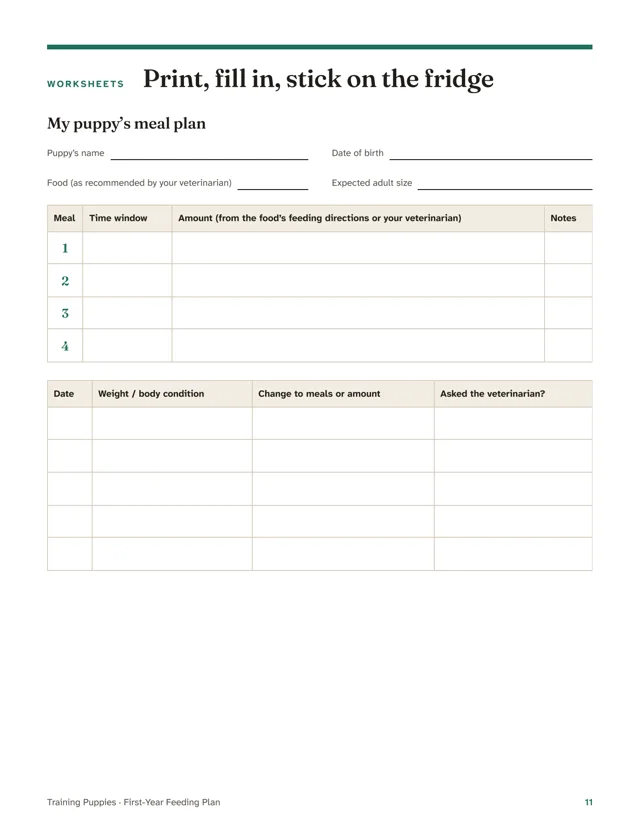
Download this guide as a free 14-page PDF with a fill-in meal plan and a one-week routine log for the fridge.
- The plan at a glance, stage by stage
- A five-step daily routine
- Seven ways meals build skills
- A meal plan and one-week log to fill in
PDF · 14 pages · 0.6 MB · no sign-up
2fill-in worksheets